
Last updated: October 2026 | Square prices checked on Square’s official pricing page; Toast figures from Toast’s site and independent pricing reviews (Toast quotes most prices individually)
Disclosure: SmallBiz Stack is reader-supported. Some links on this site may be affiliate links, which means we may earn a commission at no extra cost to you. This never changes our verdicts. Prices change often, so confirm the current rate on the vendor’s site before you sign up.
Square and Toast are two of the most common point-of-sale systems in American restaurants. Square started as a card reader for any small business and built a dedicated restaurant product on top. Toast was built from day one for restaurants only, with kitchen displays, handheld ordering and restaurant-specific reporting at its core.
The way they sell is just as different as the products. Square publishes its plans and processing rates. Toast publishes a starting price and quotes most of the rest after a sales call.
Square vs Toast at a glance
| Square for Restaurants | Toast | |
|---|---|---|
| Software plans | Free, Plus ($49/mo per location), Premium ($149/mo per location) | Starter Kit ($0/mo), Point of Sale (from $69/mo), custom plans |
| In-person card rate | 2.6% + 15¢ (Free), 2.5% + 15¢ (Plus), 2.4% + 15¢ (Premium) | About 3.09% + 15¢ on Starter Kit; about 2.49% + 15¢ on paid plans (reported) |
| Online card rate | 3.3% + 30¢ (Free), 2.9% + 30¢ (Plus and Premium) | Varies by plan and add-ons |
| Kitchen display (KDS) | $30/mo per device (Plus), $20 (Premium) | Hardware about $674 + $35/mo per screen (reported) |
| Pricing published? | Yes | Partly; most plans are quoted |
| Contract | Month to month | Often one to three years with early termination fees (reported) |
| Best for | Cafés, quick service, new restaurants, multi-use businesses | Full-service and high-volume restaurants that want an all-restaurant system |
Square for Restaurants pricing in 2026
| Square plan | Monthly per location | In-person rate | Online rate | Manually keyed | KDS app | Kiosk app |
|---|---|---|---|---|---|---|
| Free | $0 | 2.6% + 15¢ | 3.3% + 30¢ | 3.5% + 15¢ | Not available | Not available |
| Plus | $49 | 2.5% + 15¢ | 2.9% + 30¢ | 3.5% + 15¢ | $30/mo per device | $50/mo per device |
| Premium | $149 | 2.4% + 15¢ | 2.9% + 30¢ | 3.5% + 15¢ | $20/mo per device | $30/mo per device |
Square hardware starts at $59 for a basic reader, and you can buy registers, terminals and kitchen printers outright.
Toast pricing in 2026
Toast’s website lists pricing “starting at $0/month” and asks you to get a quote for the rest. Independent reviews of Toast’s pricing report the following structure:
| Toast plan | Monthly software | Card processing (reported) |
|---|---|---|
| Starter Kit | $0 | 3.09% + 15¢ base; higher (3.39%–3.69% + 15¢) with online ordering, gift cards or marketing add-ons |
| Point of Sale | From $69 | About 2.49% + 15¢ |
| Build Your Own | Custom quote | Custom quote |
Reported Toast hardware prices include about $494 for the Toast Go 2 handheld, $719 plus $50 a month for a Flex terminal, $674 plus $35 a month per kitchen display screen and around $300 each for kitchen and receipt printers. Toast offers 0% hardware financing to approved customers, and its software subscription includes 24/7 support (Toast Care).
Because Toast quotes individually, ask for every rate in writing: the card rate for in-person, online and keyed transactions, monthly software and hardware fees, contract length and the early termination fee.
Cost example: a restaurant doing $40,000 a month in card sales
Assume an average ticket of $35, which is about 1,143 card transactions a month, all in person.
| Setup | Software | Processing | Estimated monthly total |
|---|---|---|---|
| Square Plus | $49 | 2.5% × $40,000 + 15¢ × 1,143 = $1,171 | About $1,220 |
| Square Premium | $149 | 2.4% × $40,000 + 15¢ × 1,143 = $1,131 | About $1,280 |
| Toast Point of Sale (reported rates) | $69 | 2.49% × $40,000 + 15¢ × 1,143 = $1,167 | About $1,236 |
| Toast Starter Kit (reported rates) | $0 | 3.09% × $40,000 + 15¢ × 1,143 = $1,407 | About $1,407 |
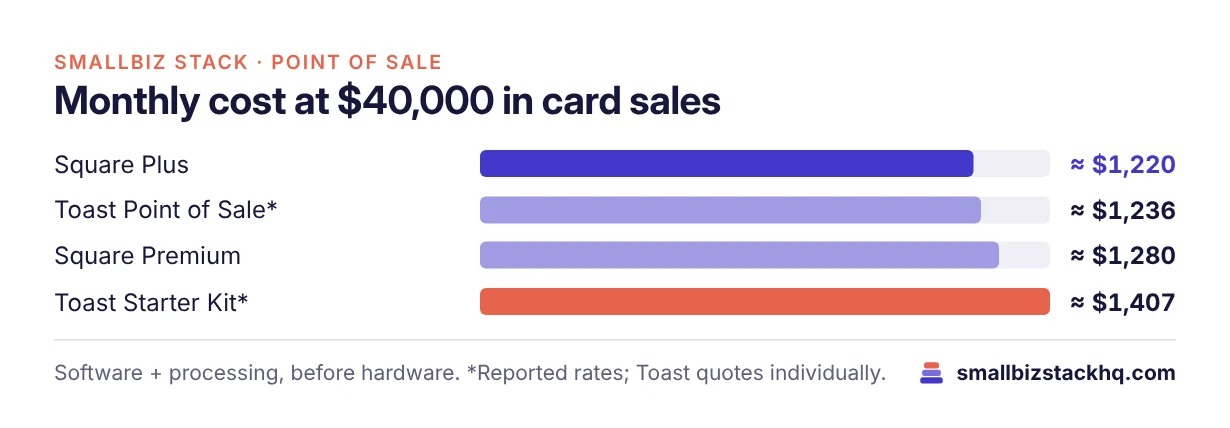
Before hardware and kitchen displays, Square Plus and Toast’s paid plan cost almost the same at this volume. Toast’s no-monthly-fee Starter Kit ends up the most expensive because of its higher card rate. Square Premium only pays off at higher volume: its lower rate saves $40 per $40,000, so you need about $100,000 a month in card sales before the extra $100 subscription breaks even.
Features compared
Built for restaurants
Toast’s whole product is restaurant software: table management, coursing, menu modifiers, kitchen routing, handheld ordering at the table and restaurant-focused reporting. Square for Restaurants covers the same core needs and is strong for counter service, cafés and quick-service spots, and it shares a platform with Square’s retail and appointments tools.
Kitchen displays
Square’s KDS app costs $30 a month per device on Plus and $20 on Premium; it isn’t available on the Free plan. Toast sells dedicated kitchen display hardware with a monthly fee per screen.
Online ordering
Both offer online ordering. Square’s online rate is 2.9% + 30¢ on Plus and Premium. With Toast’s Starter Kit, adding online ordering raises the card rate on orders, according to independent reviews, so ask how online orders are priced on the plan you are quoted.
Payroll and team management
Square sells payroll and team management separately. Toast offers a payroll bundle with its POS for an extra monthly fee plus a per-employee charge.
Contracts and flexibility
Square plans are month to month, so you can change plans or leave without a penalty. Toast agreements commonly run one to three years with an early termination fee, according to independent reviews. For a new restaurant, that flexibility is worth a lot.
Pros and cons
Square for Restaurants
Pros
- Transparent published pricing
- No long-term contract
- Free plan to get started
- Simple setup and affordable hardware
Cons
- KDS and kiosk cost extra per device
- Fewer full-service features than Toast
- Higher online rate on the Free plan
Toast
Pros
- Built only for restaurants, with deep full-service features
- Durable handheld and kitchen hardware
- 24/7 support included
- Hardware financing available
Cons
- Most pricing is quote-only
- Multi-year contracts with termination fees are common
- Starter Kit card rates are high
Which should you choose?
Choose Square if you run a café, quick-service restaurant, food truck or a new place where flexibility matters, or you want published prices and no contract.
Choose Toast if you run a full-service or high-volume restaurant, you want handheld ordering and deep kitchen workflows, and you are comfortable negotiating a contract with clear rates in writing.
Frequently asked questions
Is Toast more expensive than Square?
Not necessarily on software and processing. At $40,000 a month in card sales, Toast’s paid plan and Square Plus cost about the same before hardware. Toast can cost more once you add hardware subscriptions and if your contract carries higher rates for online orders.
Does Square require a contract?
No. Square for Restaurants plans are month to month.
Can I use Toast without paying a monthly fee?
Yes. The Starter Kit has no monthly software fee, but its card processing rate is higher, so it usually costs more once you process real volume.
Which is better for a coffee shop?
Square, for most coffee shops. Its Free and Plus plans, fast counter checkout and month-to-month terms fit quick-service businesses well.
Can I bring my own payment processor?
Neither is designed for that. Both process card payments themselves as part of the service, which is why comparing card rates is essential.
The bottom line
Square is the flexible, transparent choice, and for most cafés and quick-service restaurants it is the safer bet. Toast is the more specialized restaurant system and makes sense for busy full-service restaurants, as long as you get every fee and contract term in writing before you sign.
Related: setting up payroll for your staff? See Gusto vs ADP RUN. Need accounting software? Read QuickBooks Online vs Xero.