
Last updated: October 2026 | Prices checked against Shopify’s official pricing page
Disclosure: SmallBiz Stack is reader-supported. Some links on this site may be affiliate links, which means we may earn a commission at no extra cost to you. This never changes our verdicts. Prices change often, so confirm the current rate on the vendor’s site before you sign up.
Shopify’s plans look like a simple ladder of features, but the real reason to upgrade is usually money: higher plans have lower card processing rates. Once your store sells enough, a more expensive plan can actually cost less overall. This guide compares Basic, Grow, Advanced and Plus and shows where the break-even points are.
Shopify plans at a glance
| Plan | Billed yearly | Billed monthly | Online card rate | Fee if not using Shopify Payments | Extra staff accounts |
|---|---|---|---|---|---|
| Basic | $29/mo | $39/mo | 2.9% + 30¢ | 2% | None |
| Grow | $79/mo | $105/mo | 2.7% + 30¢ | 1% | 5 |
| Advanced | $299/mo | $399/mo | 2.5% + 30¢ | 0.6% | 15 |
| Plus | From $2,300/mo | — | 2.25% + 30¢ | 0.2% | Unlimited |
When we checked, Shopify offered a short free trial followed by $1 a month for the first three months on most plans.
When does upgrading pay for itself?
Each step up lowers your online card rate. Here’s the monthly online sales level where the lower rate covers the higher subscription (yearly billing, using Shopify Payments):
| Upgrade | Extra monthly cost | Rate saving | Break-even monthly sales |
|---|---|---|---|
| Basic → Grow | $50 | 0.2% | $25,000 |
| Grow → Advanced | $220 | 0.2% | $110,000 |
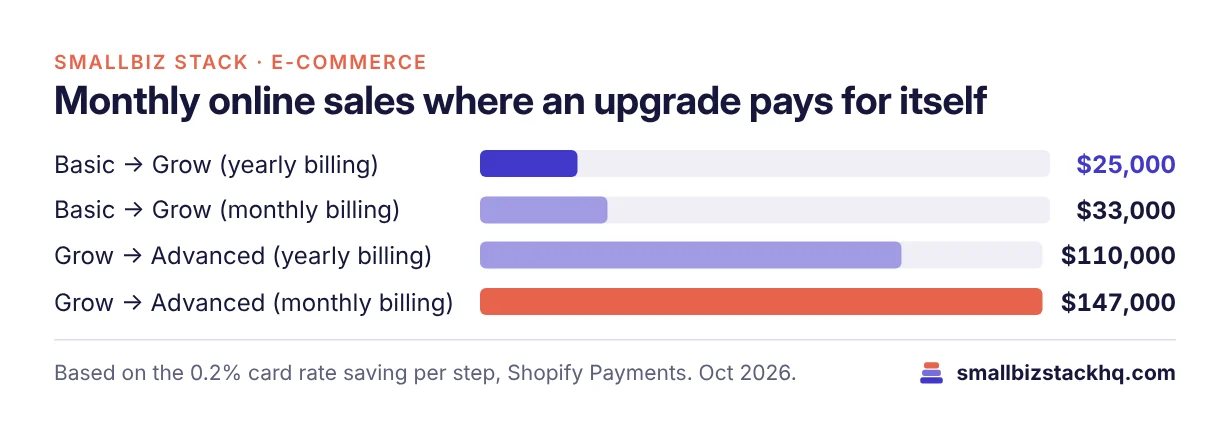
On monthly billing, the extra cost is $66 for Basic → Grow (break-even about $33,000) and $294 for Grow → Advanced (about $147,000).
Rule of thumb: stay on Basic until you sell around $25,000 a month online, then consider Grow. Advanced only pays off on rates alone above roughly $110,000 a month, unless you need its features.
What each plan adds
Basic
Everything you need to run a store: online store, unlimited products, checkout, discount codes, abandoned cart recovery, basic reports and sales channels. No extra staff accounts. Ideal for new and small stores.
Grow
Lower card rate, 5 additional staff accounts and more reporting. The upgrade most growing stores make first, either for the rate saving or to give team members their own logins.
Advanced
The lowest standard card rate below Plus, 15 additional staff accounts, more advanced reports and features for larger catalogs and international selling. For established stores with a team.
Plus
For high-volume and enterprise brands, with the lowest rates, unlimited staff and advanced customization and automation. Pricing starts at $2,300 a month.
Three real-world examples
A new candle shop selling $3,000 a month. Basic at $29 a month is the obvious fit. Grow would cost $600 more a year and save only $72 in card fees.
A clothing brand selling $40,000 a month with 3 staff. Grow saves $80 a month in card fees against a $50 higher subscription, and gives each staff member a login. Upgrade.
A supplement brand selling $150,000 a month. Advanced saves $300 a month in card fees against Grow for $220 more a month, and adds staff accounts and reporting. Upgrade.
Don’t forget the third-party payment fee
If you use a payment provider other than Shopify Payments, Shopify adds its own fee on top: 2% on Basic, 1% on Grow, 0.6% on Advanced and 0.2% on Plus. For most US stores, using Shopify Payments is the cheaper option.
Other costs to budget for
- Apps: Many stores pay for a few apps for reviews, subscriptions, email or upsells.
- Themes: Free themes are available; premium themes are a one-time purchase.
- Domain: About $10–$20 a year.
- Email marketing: See Klaviyo vs Mailchimp.
Questions to ask before you upgrade
- What were your online sales over the last three months? Use a real average, not your best month, to compare against the break-even points above.
- Do you pay yearly or monthly? The break-even point is lower on yearly billing because the price gap between plans is smaller.
- How many people need their own login? Basic has no extra staff accounts, so a growing team may need Grow for access control alone.
- Are you using Shopify Payments? If not, the third-party fee (2% on Basic) usually makes an upgrade or a switch to Shopify Payments worth it much sooner.
- Which reports do you actually use? Advanced reporting only matters if someone will act on it.
A quick worked example
A home goods store sells $32,000 a month online with an average order of $64, so about 500 orders. On Basic (yearly billing), card fees are 2.9% × $32,000 + 30¢ × 500 = $1,078, plus $29 for the plan: $1,107 a month. On Grow, card fees are 2.7% × $32,000 + $150 = $1,014, plus $79: $1,093 a month. Grow is $14 a month cheaper and adds five staff accounts, so the upgrade makes sense.
Frequently asked questions
Is Shopify Plus worth it for a small business?
Rarely. Plus starts at $2,300 a month and is designed for high-volume brands that need advanced customization, automation and dedicated support. Most small businesses are better served by Basic, Grow or Advanced.
Which Shopify plan is best for beginners?
Basic. It has everything you need to launch and costs the least.
Is yearly billing worth it?
Yes, if you’re confident you’ll keep the store for a year. It cuts Basic from $39 to $29 a month and Grow from $105 to $79.
Can I change plans later?
Yes. You can upgrade or downgrade at any time from your Shopify admin.
Does Shopify charge transaction fees?
Not if you use Shopify Payments. If you use another payment provider, Shopify adds 0.2% to 2% depending on your plan.
The bottom line
Start on Basic. Move to Grow around $25,000 a month in online sales or when your team needs more logins. Consider Advanced only at high volume or for its features. Compare with other platforms in Shopify vs WooCommerce and Shopify vs BigCommerce.