
Last updated: October 2026 | Prices checked against Shopify’s and BigCommerce’s official pricing pages
Disclosure: SmallBiz Stack is reader-supported. Some links on this site may be affiliate links, which means we may earn a commission at no extra cost to you. This never changes our verdicts. Prices change often, so confirm the current rate on the vendor’s site before you sign up.
Shopify and BigCommerce are the two biggest hosted e-commerce platforms. In 2026, their subscription prices line up almost exactly: $29, $79 and $299 a month on yearly billing. So the real differences are elsewhere: card processing rates, BigCommerce’s yearly sales limits, payment provider fees and how many features each includes without apps.
Shopify vs BigCommerce at a glance
| Shopify | BigCommerce | |
|---|---|---|
| Entry plan | Basic, $29/mo yearly ($39 monthly) | Core, $29/mo yearly ($39 monthly) |
| Mid plan | Grow, $79/mo yearly ($105 monthly) | Growth, $79/mo yearly ($105 monthly) |
| Upper plan | Advanced, $299/mo yearly ($399 monthly) | Scale, $299/mo yearly ($399 monthly) |
| Card processing (entry) | 2.9% + 30¢ (Shopify Payments) | From 2.89% + 29¢ |
| Fee for other payment providers | 2% / 1% / 0.6% | 2% / 1% / 0.6% on open providers; none on embedded providers |
| Yearly online sales cap | None | Core up to $30K, Growth up to $100K (trailing 12 months) |
| Best for | Most stores, especially fast-growing brands | Stores that want more built-in features or payment flexibility |
Shopify pricing in 2026
| Plan | Yearly | Monthly | Online card rate |
|---|---|---|---|
| Basic | $29 | $39 | 2.9% + 30¢ |
| Grow | $79 | $105 | 2.7% + 30¢ |
| Advanced | $299 | $399 | 2.5% + 30¢ |
| Plus | From $2,300 | — | 2.25% + 30¢ |
BigCommerce pricing in 2026
| Plan | Yearly | Monthly | Online sales limit (trailing 12 months) | Open payment provider fee |
|---|---|---|---|---|
| Core | $29 | $39 | Up to $30,000 | 2.0% |
| Growth | $79 | $105 | Up to $100,000 | 1.0% |
| Scale | $299 | $399 | $33,333/month, with 0.9% overage above that | 0.6% |
| Performance | From $1,499 (annual) | — | Custom | 0% with contract |
BigCommerce says card processing begins at 2.89% + 29¢ on all plans, and embedded payment providers carry no BigCommerce fee. Core, Growth and Scale have no contract.
The sales cap is the key difference
Shopify doesn’t limit your sales on any plan. BigCommerce moves you up a plan when your trailing 12-month sales pass the limit:
| Yearly online sales | Shopify (can stay on) | BigCommerce (required plan) |
|---|---|---|
| $25,000 | Basic, $29/mo | Core, $29/mo |
| $60,000 | Basic, $29/mo | Growth, $79/mo |
| $150,000 | Basic or Grow | Scale, $299/mo |
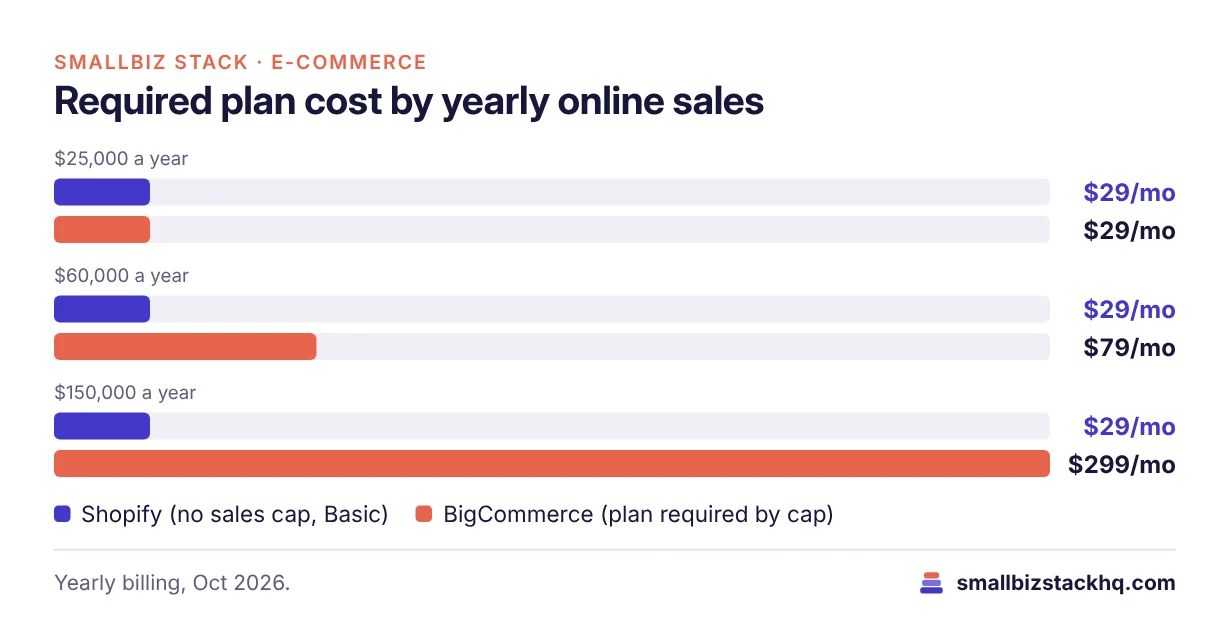
A store selling $60,000 a year could stay on Shopify Basic for $348 a year, while BigCommerce would require Growth at $948 a year. That said, at $60,000 a year Shopify Grow would save only about $120 a year in card fees against its $600 higher cost, so Basic is the sensible choice there.
Features compared
Built-in features
BigCommerce has long included more features without apps, such as product options and some B2B tools. Shopify relies more on its huge App Store, which offers enormous choice but can add monthly app fees.
Ecosystem and themes
Shopify’s ecosystem of apps, themes, agencies and integrations is the largest in e-commerce. BigCommerce’s is smaller but solid.
Payments
Shopify works best with Shopify Payments; other providers add a fee. BigCommerce charges no platform fee with embedded payment providers, which gives more flexibility in choosing a processor.
Multichannel and B2B
Both sell across marketplaces and social channels. BigCommerce has historically been strong for B2B and wholesale features; Shopify offers B2B features mainly on Plus.
Three real-world scenarios
A new apparel brand expecting fast growth. Shopify Basic with no sales cap and the largest app ecosystem is the safest start.
A wholesale parts supplier with complex product options. BigCommerce’s built-in product options and B2B features may reduce app costs.
A store selling $70,000 a year that wants to keep costs low. Shopify Basic avoids BigCommerce’s forced upgrade to Growth.
Questions to ask before you sign up
- How much will you sell in the next 12 months? BigCommerce’s caps may force an upgrade.
- Which payment provider do you want? Compare platform fees for non-native providers.
- Which features will need apps? Add expected app costs to the subscription.
- Do you sell B2B or wholesale? Check each platform’s B2B features at your plan level.
- Do you need an agency or developer? Shopify’s partner network is larger.
Cost example: a store selling $8,000 a month
A store selling $96,000 a year with an average order of $60 (about 133 orders a month):
| Platform | Plan required | Plan cost | Card fees | Monthly total |
|---|---|---|---|---|
| Shopify | Basic (no cap) | $29 | 2.9% × $8,000 + 30¢ × 133 = $272 | About $301 |
| BigCommerce | Growth (over $30K a year) | $79 | 2.89% × $8,000 + 29¢ × 133 = $270 | About $349 |
At this volume, BigCommerce’s sales cap pushes the store onto Growth, making it about $48 a month more expensive than Shopify Basic.
Frequently asked questions
Can I use Shopify Payments with BigCommerce?
No. Shopify Payments works only on Shopify. BigCommerce offers its own embedded payment providers with no platform fee.
Is BigCommerce cheaper than Shopify?
Subscription prices are identical. BigCommerce’s entry card rate (2.89% + 29¢) is a touch lower, but its sales caps can force a more expensive plan.
Does BigCommerce charge transaction fees?
Not with embedded payment providers. Open payment providers carry a 0.6% to 2% fee depending on your plan.
What happens if I exceed BigCommerce’s sales limit?
You’re moved to the next plan. On Scale, sales above $33,333 a month carry a 0.9% overage.
Which is easier for beginners?
Shopify is generally considered easier, with a larger library of guides, themes and apps.
The bottom line
Shopify is the better choice for most stores, thanks to no sales caps and the largest ecosystem. BigCommerce suits stores that want more built-in features or flexibility with payment providers and expect to stay under its sales limits. See also Shopify plans compared and Shopify vs WooCommerce.